
Digitising Córdoba's Provincial Art Collection
A thousand artworks from three museums, captured in HDR and given a place to live online
- Three.js
- HDR Imaging
- Unreal Engine
- Pannellum
- Canon
- Sony
Where it started
When the province called, the ask was big and specific at once: it owned around 1,000 artworks — paintings in every technique, sculptures, textiles — spread across three museums, Museo Evita Palacio Ferreyra and Museo Emilio Carafa among them. Most of it had spent years in storage, unseen. The Ministry of Technology and the Secretaría de Cultura wanted the whole collection captured and taken somewhere the public could actually reach it.
What we set out to do
We were after two things at once. To photograph a thousand works at a quality the institutions would sign off on — detailed enough that you could make out the very brushstrokes the artist left behind. And to build a place online where anyone could walk the collection: not a spreadsheet of thumbnails, but something you could explore.
How we found our way
Capture took about three and a half months, plus a long stretch of post-production. We had no prior experience with a project of this size, so preparation came first, and it was crucial. We shot mostly on Canon gear (some Sony) on a Manfrotto tripod. For each piece we took four exposures — from low to high luminosity, in a progression — and then merged them into a single HDR image, so colour held up on both the dark works and the bright ones.
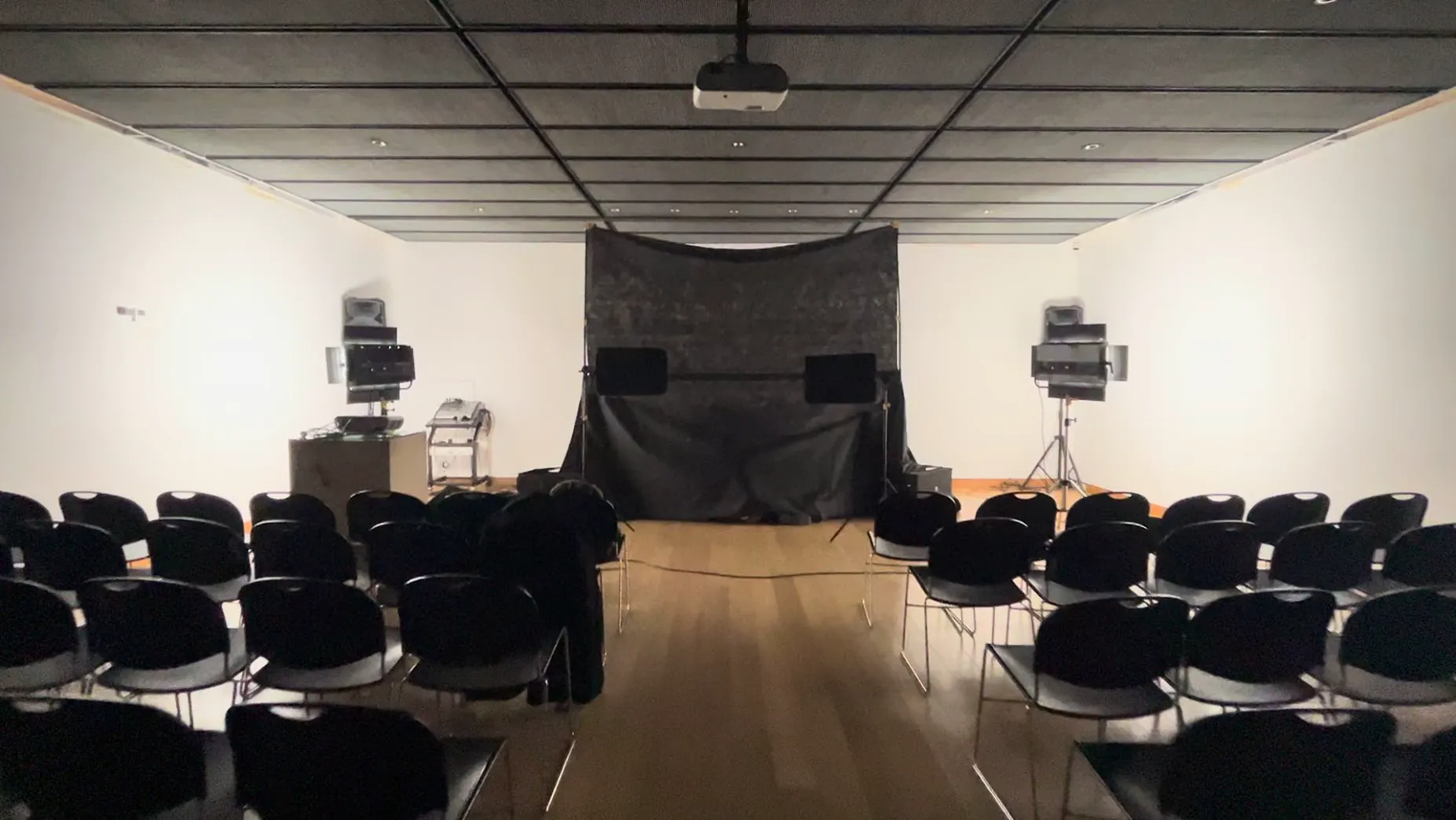
Reflections were the enemy the whole way through. Every framed, glassed painting bounced the room's light back, so we built the set from scratch each day: two rigs holding black anti-reflective cloth, the tripod, and rented reflectors. We worked in a room in the basement of Museo Evita — quiet, very cold, but with lighting control so precise it was worth the discomfort: we kept it in total darkness and dialled the light in by hand. Operators often had to hide literally inside the fabric so they wouldn't show up in a reflection, and more than one shot had to be redone because the glare crept in anyway.
The site we built with our own design, adding Three.js — not to display models, but for an interactive 3D map on the home screen with the three museums, from which a visitor picks one and explores its collection.
The hardest part
The works that weren't on display became a design problem of their own. Since the tour was the way into the collection, a piece that hung on no scanned wall was orphaned: it had nowhere to live. Rather than dump them in a flat gallery, we invented a place for them. We modelled and textured a fictional virtual museum, rendered it out of Unreal Engine in equirectangular format — Blender's renderer wasn't enough here, we needed higher-fidelity output — and turned it into a navigable 360° tour with Pannellum. We laid it out as modular "islands" of about twelve works each, linked together, so the archive felt like a real place instead of a digital storeroom.

“A work no one can walk up to might as well not be online”
Where it is today
The collection is online and navigable across the three museums, with the virtual archive holding everything that isn't on the walls. The lesson that stuck was almost counterintuitive: on a job this size, the cataloguing and the paperwork of moving artworks are as much of the project as the cameras and the code.
- Nicolas Gandolfo — Design & Innovation Lead
- Guadalupe Rickel — Project Manager · Creative · Cinematic Specialist
- Tomas Celoira Prince — Product Designer · Creative · 3D Artist
Products in the wild
- AI Guide Totem — Museo Emilio Carafa →A photoreal 3D guide on a touchscreen totem, answering visitors in real time
- Digital Twin — Museo Evita Palacio Ferreyra →A navigable virtual twin of the museum, layered with narration and 3D detail
- VR Experience — Academia Nacional de Ciencias, Conquista del Desierto →Grab a lamp and a museum room becomes a Patagonia that talks back