
VR Experience — Academia Nacional de Ciencias, Conquista del Desierto
Grab a lamp and a museum room becomes a Patagonia that talks back
- Unreal Engine 5.2
- Blender
- MetaHuman
- Live Link Face
- Text-to-Speech
Where it started
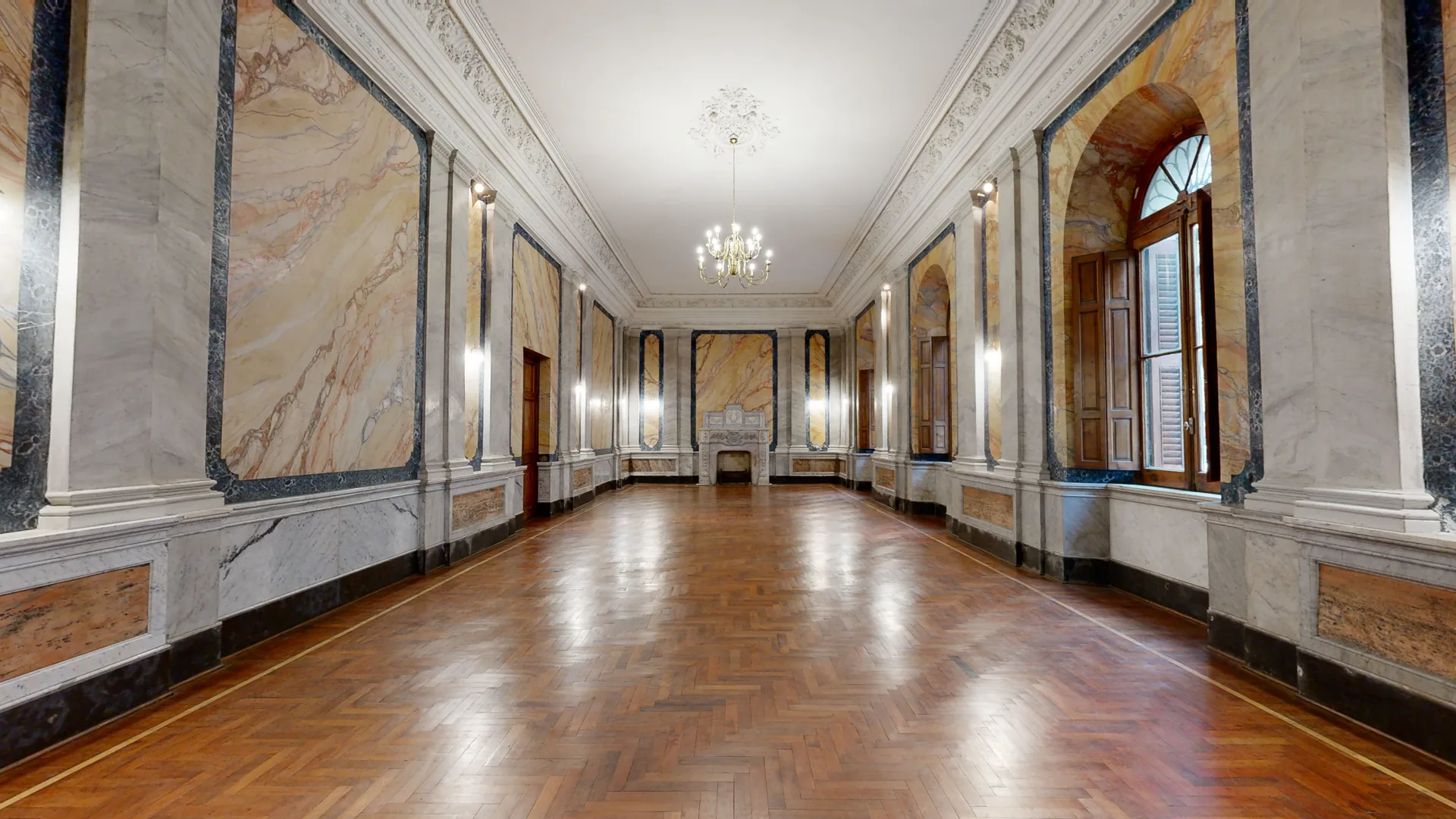
The VR piece for Museo Evita had worked, so we did one for the Academia too, building on the digital twin we'd already scanned and its measurements. The subject was set by the place itself: the Academia's role in the Conquista del Desierto. Around 1890, on hearing of the expedition into an Argentine south with no records yet of its flora, fauna or geology, the Academia had pushed to send its scientists along on that military campaign. It's also the same scene that appears on the back of the 100-peso note, with Julio Argentino Roca and the academics.
What we set out to do
Our main worry was obvious. The experience would be shown inside the museum's own real room; walking people there, putting a headset on them, and having them still see that same room made no sense. We wanted the exact opposite: for the real room to dissolve into a mythical Patagonia, so the experience didn't feel like "the same place, now with goggles."
How we found our way
We rebuilt the main room in Unreal Engine, modelling in Blender and texturing in Substance Painter, with dynamic lighting throughout. The trigger is an antique lamp: grab it, and arid Patagonian flora rises out of the floor and fills the room while military figures and academics arrive on horseback from the back. And the characters actually speak. There's Julio Argentino Roca and two founding academics, one of them Pablo Lorentz, each telling their version of the story first-hand when the visitor stands in front of them.
For that we built our own lip-sync pipeline, which turned out to be the project's biggest innovation. No tool existed that could take an audio file and animate the model's face satisfactorily, so we did it by hand: we wrote the script, ran it through text-to-speech, and then, with that audio playing, the person doing the modelling filmed themselves miming the expressions of someone saying those words. Those recordings were captured with Live Link Face and transferred onto the model, which fed off them to move its lips in sync. We repeated it three times, once per character.
The hardest part
That pipeline was hand-built and had to be redone in full for each character — there was no shortcut. But it's also what landed hardest with the public. Seeing historical figures speak face to face inside VR was something people hadn't seen before, and it's what they took with them on the way out.

“When no tool is good enough, a human performance becomes the tool”
Where it is today
Like the Museo Evita piece, it's an event-scale experience, currently paused between showings. The talking-character technique became a reference point for our later work with AI museum guides.
- Nicolas Gandolfo — Design & Innovation Lead
- Guadalupe Rickel — Project Manager · Creative · Cinematic Specialist
- Tomas Celoira Prince — Product Designer · Creative · 3D Artist
Products in the wild
- AI Guide Totem — Museo Emilio Carafa →A photoreal 3D guide on a touchscreen totem, answering visitors in real time
- Digital Twin — Museo Evita Palacio Ferreyra →A navigable virtual twin of the museum, layered with narration and 3D detail
- Digitising Córdoba's Provincial Art Collection →A thousand artworks from three museums, captured in HDR and given a place to live online