
3D Artifact Scanning — Museo Evita
Turning the building's overlooked details into objects you can hold in the tour
- LiDAR
- iPhone
- Photogrammetry
- 3D Scanning
Where it started
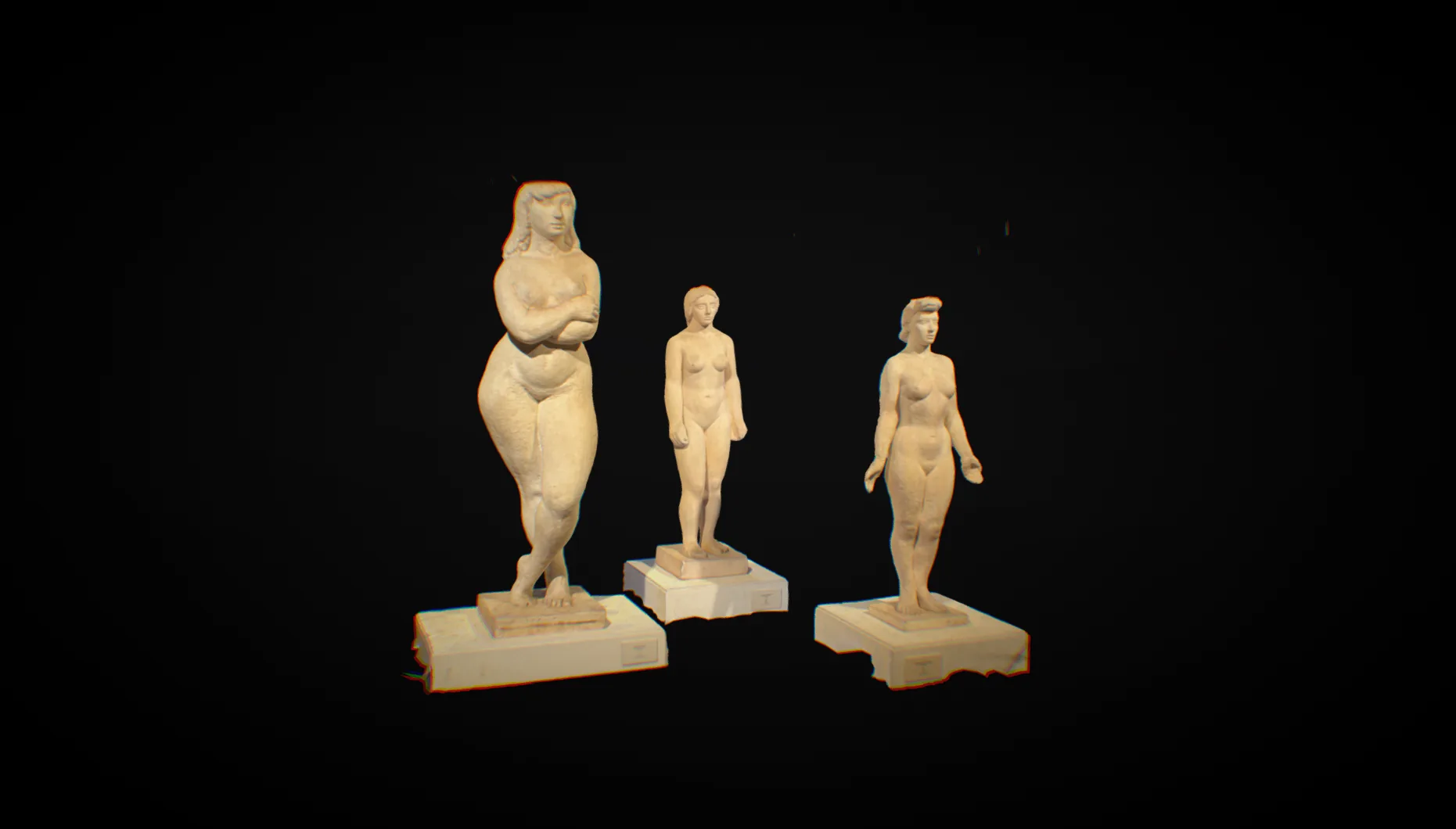
While we were building the digital twin of Palacio Ferreyra, we noticed something we hadn't planned for: visitors cared about the moldings, the ironwork and the great branching cast-iron staircase as much as about the art on the walls. It makes sense — when the palace was built, every piece of hardware was commissioned to order from a craftsman, because there was no shop to buy it from. All that loaded detail made us wonder whether we could capture those pieces in 3D and add them to the tour as things you could pick up and turn around.
What we set out to do
The aim was to break the usual distance between visitor and object. Not a photo of a staircase railing, but a model you could rotate and inspect. And to do it with gear practical enough to use inside a working museum, on fragile or immovable pieces.
How we found our way
We scanned with the LiDAR sensor on an iPhone — at the time, the one accessible option that gave usable depth data. We also tried photogrammetry from high-quality photos alone, but without depth information the results were poor; with LiDAR the quality jumped noticeably. The technique was simple to describe and slow to do well: circle the object with the camera across a full sphere of angles, taking as many photos as possible from as many positions as possible. The resulting models went straight into the digital twin as one more interactive layer.
What got in the way
The sensor has hard limits. Transparent and highly reflective materials — glass, acrylic, polished metal — throw off the depth reading and the model breaks; those objects we simply took off the list. Space was the other constraint: an object against a wall can't be circled, and anything fragile, heavy or in storage dragged along paperwork and handling rules that slowed everything down. Because the project came up mid-scan, we couldn't agree on an object list in advance either; we chose pieces by how much each one taught us about what can and can't be scanned.

“People connect with the details, not just the masterpieces”
Where it is today
The scanned pieces live inside the Museo Evita twin as an extra layer of interactivity. The most valuable thing was the principle left behind: people connect with the details, not just the masterpieces. That idea carried into every project that came after.
- Nicolas Gandolfo — Design & Innovation Lead
- Guadalupe Rickel — Project Manager · Creative · Cinematic Specialist
- Tomas Celoira Prince — Product Designer · Creative · 3D Artist
Products in the wild
- AI Guide Totem — Museo Emilio Carafa →A photoreal 3D guide on a touchscreen totem, answering visitors in real time
- Digital Twin — Museo Evita Palacio Ferreyra →A navigable virtual twin of the museum, layered with narration and 3D detail
- VR Experience — Academia Nacional de Ciencias, Conquista del Desierto →Grab a lamp and a museum room becomes a Patagonia that talks back