
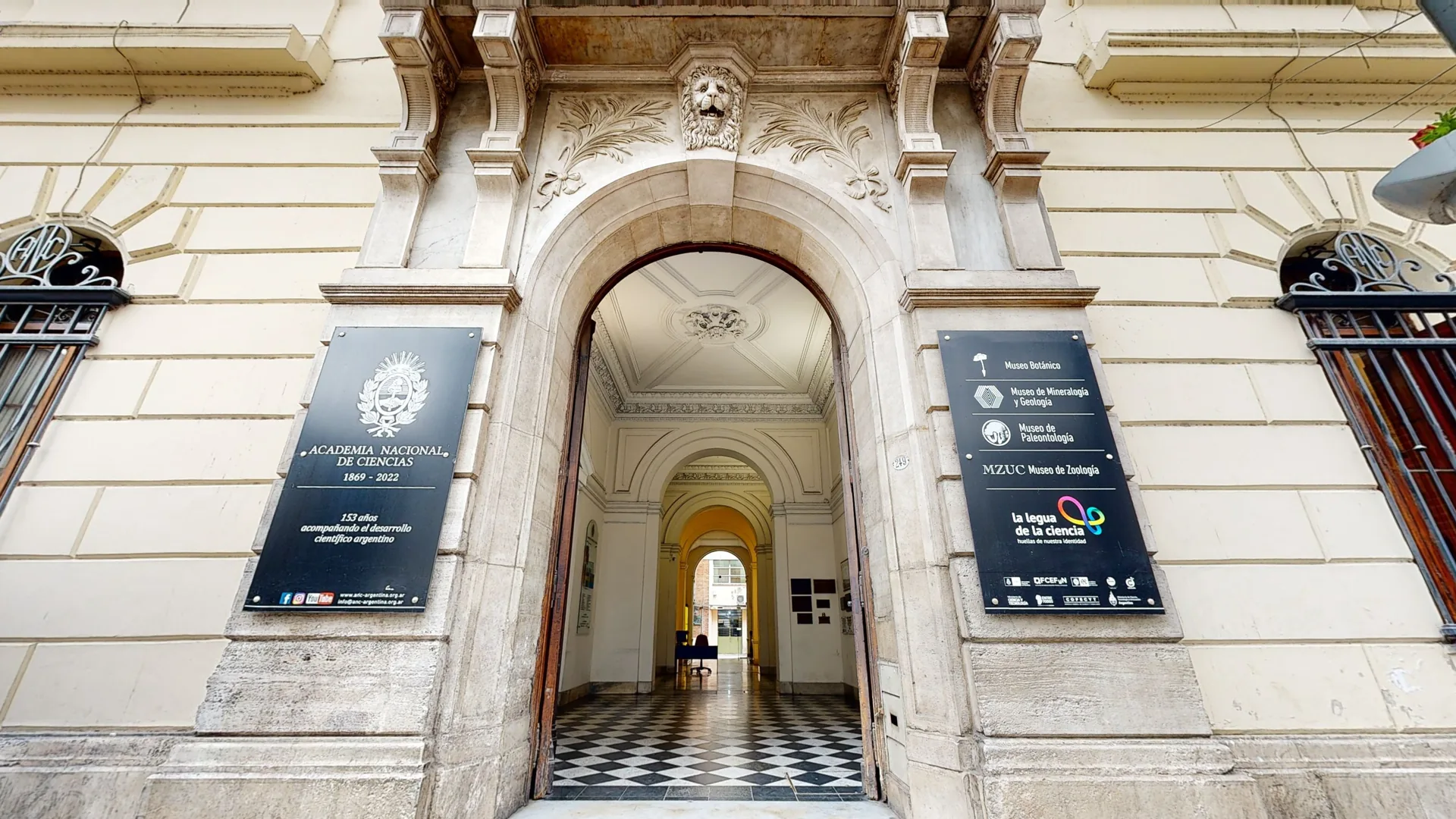
Digital Twin — Academia Nacional de Ciencias de Córdoba
A virtual twin of a 6,000 m² scientific institution, told through its objects
- Matterport
- Photogrammetry
- 3D Scanning
- Text-to-Speech
Where it started
After Museo Evita, the province asked us to do the same for the Academia Nacional de Ciencias de Córdoba. They came on the government's recommendation, happy with the Palacio Ferreyra tour. The Academia is an institution founded in Sarmiento's time — he wanted to move the country's scientific centre away from Buenos Aires and brought European specialists in botany, paleontology and geology to Córdoba. It's a building of roughly 6,000 m² and nearly 170 years, holding enormous historical weight, yet rarely visited: what they arrived with, above all, was a need for visibility. Gonzalo, the Academia's guide, worked alongside us throughout.
What we set out to do
We wanted to carry over what had worked at Museo Evita — a narrated, readable space with real accessibility — and apply it to a collection that is mostly scientific: fossils, minerals, meteorites, botanical records, instruments. The story here wasn't art history; it was the history of science in Córdoba, spread across several museums living under one roof.
How we found our way
We used the same approach as the first twin: Matterport and photogrammetry for the space, then a narrative layer of points of interest with audio, text, images and embedded 3D models. Before scanning, we did a two-day initial walkthrough with Gonzalo — the building is far larger than Palacio Ferreyra — marking points of interest as we got to know the rooms and deciding together which parts of the history belonged in the story. Working this way was far more fluid than the first time: we'd already made most of our beginner mistakes, so the collaboration felt more like a conversation than a negotiation. We scanned around twenty pieces among fossils, plants, scientists' notebooks, gemstones, meteorites and instruments.
What got in the way
The building is shared with a university faculty, and that made logistics tight: there was no clear line between the two spaces, and the constant flow of students and visitors made it nearly impossible to keep rooms clear. The inner courtyard was the best example: shared with the faculty, in use all week, and — being open and full of pigeons — usually rather dirty. We ended up scanning it over a weekend, after a thorough clean. And part of the collection simply couldn't be captured: the taxidermied fauna, with fur and specimens in jars, breaks the scanning process (we tell that story in detail in the artifact-scanning project).

“You can't scan a space you don't control”
Where it is today
The twin went live and was shown at Noche de los Museos alongside Museo Evita, again with around twenty VR headsets the Ministry provided so people could walk it as immersively as possible. It confirmed something we'd suspected since the first project: the method travels well, but every institution rewrites its own narration.
- Nicolas Gandolfo — Design & Innovation Lead
- Guadalupe Rickel — Project Manager · Creative · Cinematic Specialist
- Tomas Celoira Prince — Product Designer · Creative · 3D Artist
Products in the wild
- AI Guide Totem — Museo Emilio Carafa →A photoreal 3D guide on a touchscreen totem, answering visitors in real time
- Digital Twin — Museo Evita Palacio Ferreyra →A navigable virtual twin of the museum, layered with narration and 3D detail
- VR Experience — Academia Nacional de Ciencias, Conquista del Desierto →Grab a lamp and a museum room becomes a Patagonia that talks back